Posts

Showing posts with the label Stove

The Making of Capillary Action Alcohol Stove

Image
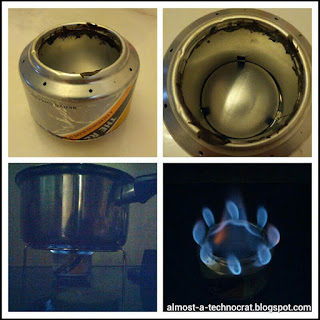
Capillary action alcohol stove in action This is a simpler stove to make. There is no epoxy needed to seal parts like the Open Jet Alcohol Stove . All i need to do, were just marking, cutting and crimping the grooves for the capillaries. This type of stove uses the crimped grooves as capillary action for the alcohol vapors to escape through it.  When the stove is lighted, it takes about few seconds to heat up the stove and boil the alcohol inside. In no time the alcohol vapors escape through the crimped grooves and catches the fire from the center hole. Immediately it creates the vapor jet flames. From my initial observation, the jet flames from the capillaries(sides) are bigger compare to my previous Open Jet Alcohol Stove . I have not run any boiling tests with this stove so i don't have any numbers to analyze the efficiency of this type of stove. I have not prepare much detail steps in making this stove but if you interested, let me know. Below are some of my photo shots i took ...

The Making of Open Jet Alcohol Stove

Image
Alcohol stoves are light and they are great to have for hiking trips and camping. They are cheap and easy to make yourself. There are several commercial types of alcohol stoves in the market with Trangia taking the top spot of all the alcohol stoves out there. Over the weekends i took some time to make one for myself. After a few tries and tests, i finally learned how to make a good alcohol stove. There are many types of alcohol stove constructions and the type i am making is the Open Jet type. There are few things i learned from my experiments: Make sure the jet holes are small enough. How small, you need to try it out by tests. I felt that 16 holes are good enough. More than that, the jet flames will start ignite slower due to slow pressure build up in the inner wall chamber and the jet flames might not look powerful. 8 holes will make the jet flames to blow further. Inserting a wick in between the walls will help to absorb almost all the alcohol into the chamber. The reason of doin...

Penny Alcohol Backpacking Stove

A very practical penny alcohol stove made and tested by Mark Jurey. A must read before you embark to make your own beer cans alcohol stoves. http://www.jureystudio.com/pennystove/

Zen Backpacking Stoves, Home of the Alcohol Stove

This website is the ultimate guide for all types of backpacking stoves, mainly the homemade ones. Zen Stoves have been an inspiration for many people out there who are making alcohol stoves on the cheap.     Zen Backpacking Stoves

Wild HM 166 - L7 Camping Stove

Image
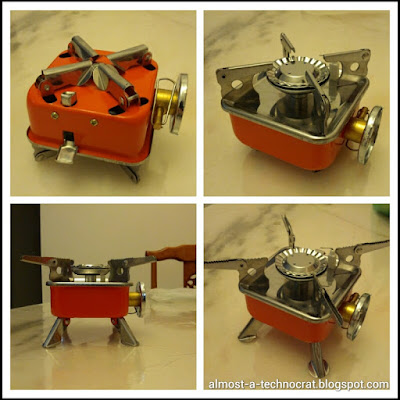
This is a great little gas stove that i got for myself for camping trips and budget travel trips where the place that i stay will not have water boiler in the room. It works with the regular household butane canister that are readily available everywhere in this part of the world (Malaysia, Thailand or Indonesia). One canister is enough to cook for a party of 10 ppl for 2 days on a camping trip. Specifications:  Size :135x165x85 mm Weight :365g Gas Consumption :100g/hr Power :6000 BTU Gas :Butane Material :Copper, stainless steel, steel

Beverage can or pop can alcohol stove

Image
This is my second attempt to make an alcohol stove from 325 milliliter aluminium beverage cans (pop can). My first attempt was a pressurized version . This stove is an easier stove to use compare to the pressurized version. All i need to do is half fill the stove with alcohol and light it up. The initial burn at the center will heat up the stove and boil the alcohol inside the stove. Alcohol vapor will then push itself out through the small holes at the side and it will get light up after a minute. This process is known as priming. Filling the pressurized version of this stove is harder as you need to slowly and carefully fill until it overflows the middle holes so you can light it up to prim. Priming time is also longer compare to this one as the initial burn is not as intense as this. Surprisingly this stove is windproof. I try to blow it off but its hard to blow the flames in the middle to off. References, Sources and Credits: https://en.wikipedia.org/wiki/Beverag...

Pressurized pop can alcohol stove

Image
This is my first attempt in making a pop can (beverage can) alcohol stove. I did not run any burn test or boil test as this is my first experiment. I was expecting jet flames effect from the side holes but the flames looked weak. I think this is due to the size of the holes. I should make the holes smaller. Smaller holes will make the pressure in the stove higher during boiling of the alcohol thus making the vapor to spray out. It will probably make it more fuel efficient too.